In modern industrial and commercial ecosystems, a caster is far more than a simple wheel attached to the bottom of a machine. It is a critical engineering component designed to solve the fundamental challenge of "Mobile Security" and "Operational Efficiency." From heavy-duty manufacturing to precision medical environments, casters define how fast, safely, and cost-effectively a business can move its assets.
As a leading global manufacturer with 25 years of expertise, KOCO explores the multi-dimensional roles that casters play in driving industrial progress.
1. The Physics of Productivity: Friction Reduction & Ergonomics
The primary role of a caster is to minimize rolling resistance. By utilizing high-precision bearings and advanced tread materials (such as KOCO’s High-Resilience PU), casters drastically reduce the force required to move heavy loads.
Operational Efficiency: In a fast-paced warehouse, a 40% reduction in starting resistance means faster turnaround times and higher throughput.
Worker Safety (Ergonomics): By reducing the physical strain required to push or pull equipment, high-quality casters prevent workplace musculoskeletal injuries, leading to lower insurance costs and better employee retention.
2. Industry-Specific Roles: Tailored Mobility Solutions
Casters are not "one-size-fits-all." Their roles change based on the industry they serve:
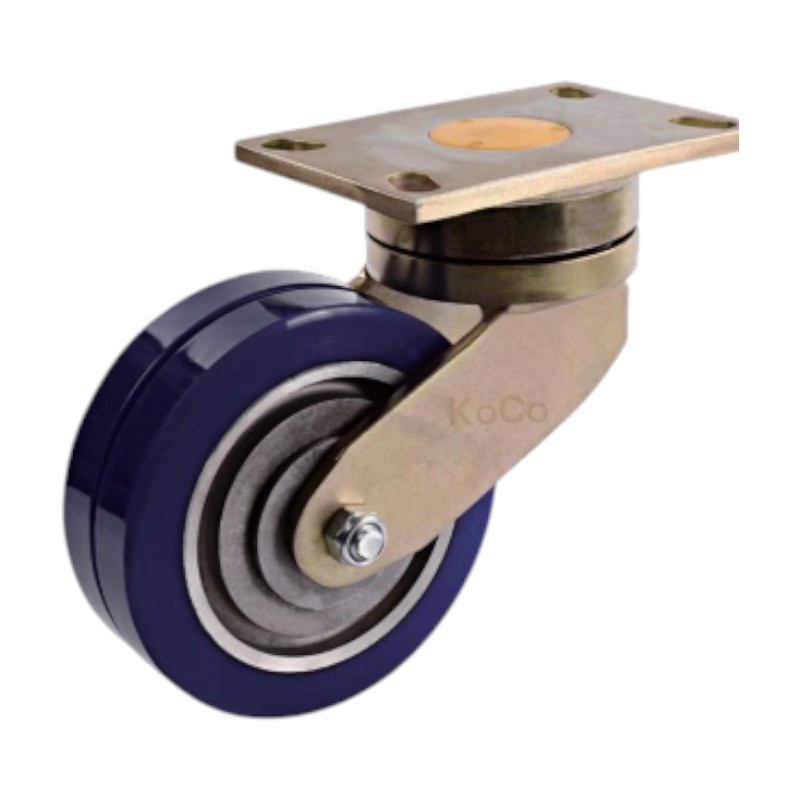
Industrial & Manufacturing: In sectors like automotive assembly (serving giants like Tesla and BMW), heavy-duty casters enable the reconfiguration of entire production lines in hours rather than days. Series like KOCO K84 (up to 10 tons) allow for the seamless movement of massive molds and machinery.
Medical & Healthcare: Here, the role shifts to Precision and Hygiene. Casters must offer silent movement and "non-marking" treads to maintain a sterile, quiet environment while ensuring life-saving equipment can be positioned with millimeter accuracy.
Logistics & AGV Systems: In the era of Industry 4.0, casters serve as the interface between robots and the floor. Specialized AGV casters provide the high-speed stability and tracking precision required for autonomous mobile robots (AMRs) to navigate complex paths.
3. Versatility through Specialized Functions
The "role" of a caster is often defined by its specific type, allowing it to adapt to diverse terrains and safety requirements:
Swivel Casters: Provide 360-degree maneuverability for precise steering in tight spaces.
Rigid (Fixed) Casters: Ensure directional stability for long-distance straight-line hauling.
Brake Systems: Vital for safety, ensuring that equipment remains stationary on inclines or during critical operations.
Shock-Absorbing Casters: Act as a suspension system to protect sensitive electronic or aerospace components from floor vibrations.
4. Economic Impact: Protecting Your Floor Assets
A secondary but vital role of casters is Asset Protection. The wrong wheel material can destroy expensive epoxy or marble floors in weeks. Professional-grade casters utilize materials like Silent TPR or Dual-Wheel Polyurethane to distribute pressure evenly, effectively extending the lifespan of your facility's flooring—an often overlooked but significant capital asset.
Understanding the role of a caster is the first step toward optimizing your supply chain. At KOCO, we leverage our 50,000 sqm manufacturing base and 2,000,000+ annual unit capacity to provide more than just parts—we provide "Moving Assurance."
Whether you are designing a new medical cart or reconfiguring a 10,000kg automotive stamping line, KOCO factory-direct expertise and 15-30 day delivery cycle ensure that your business stays in motion, safely and efficiently.